Why Your Chart of Accounts Is the Unsung Hero of Your Business’s Financial Health... and How a Messy One Can Totally Wreck Your Clarity.

Let’s talk about something that doesn’t get nearly enough credit in the world of small business: the Chart of Accounts (COA). It might not be flashy, but if your financial system were a house, the chart of accounts would be the framing. You won’t see it once the drywall’s up—but if it’s wrong, everything starts to wobble.

A well-designed COA helps you understand what’s actually happening in your business.

What Is a Chart of Accounts, Anyway?

Think of it as a financial filing cabinet. It’s a structured list of all the categories your business uses to track money coming in and going out: revenue, expenses, assets, liabilities, equity—the works. Every transaction gets filed under one of these accounts.

But here’s the thing: not all filing systems are created equal.


Why a Well-Designed Chart of Accounts Matters

1. It Gives You Clean, Actionable Data

A good COA organizes your finances in a way that makes sense for your business. It separates what you need to know from what’s just noise. Want to see how much you’re spending on software subscriptions? Or track how profitable your different services are? That’s only possible if your COA was set up with intention.

2. It Makes Tax Time (Slightly) Less Awful

When your income and expenses are clearly categorized, your accountant isn’t left playing detective every March. Fewer questions. Fewer errors. Less stress. (And possibly lower fees, because guess what—your CPA charges more when they have to untangle spaghetti.)

3. It Helps You Make Smarter Decisions

Want to cut costs? Grow a specific part of your business? Apply for a loan? You need accurate financial reports to do that. Those reports are only as good as the categories feeding them.

4. It Scales With You

If your COA is designed with your future in mind, it can grow as your business grows—without needing a total overhaul every time you add a new product, service, or location.


What Happens When Your Chart of Accounts Is a Hot Mess?


Let’s be honest—most small business COAs start out as a mess. Either someone winged it in QuickBooks, or it was copied from another business that has totally different needs. Here’s what happens when it goes off the rails:
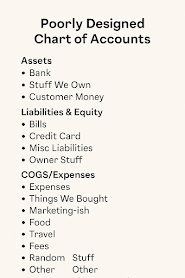
❌ You can’t tell where your money’s going. Everything’s lumped under vague categories like “Miscellaneous” or “General Expense,” which tells you… absolutely nothing.

❌ You waste time and energy. If you (or your bookkeeper) have to constantly guess where to put a transaction, you’re burning time and setting yourself up for inconsistent reports.

❌ You make bad decisions. If your data is fuzzy, your choices will be too. You might overinvest in something that looks profitable—but isn’t. Or underfund a part of your business that’s quietly carrying the team.

❌ You confuse the heck out of your accountant. No one wants to be on the receiving end of a passive-aggressive email titled “Re: Re: Clarification on that ‘Fun Stuff’ expense account?”


So What Should You Do?

✔️ Start with a custom-tailored chart of accounts that fits your business type, size, and goals—not a generic template.

✔️ Keep it lean, but detailed where it counts. Don’t go overboard with 200 accounts you’ll never use. Focus on categories that help you make decisions.

✔️ Review it regularly. Your business isn’t static—your COA shouldn’t be either. Make updates as your operations evolve.

✔️ Work with a pro. (Yes, this is where we plug ourselves.) A professional bookkeeper can help design or clean up your chart of accounts so you’re not flying blind.


Bottom Line

Your chart of accounts isn’t just some back-office bookkeeping task—it’s your business’s financial GPS. When it’s designed right, everything else runs smoother: reports, taxes, strategy, growth. When it’s not, you’re basically guessing.

Don’t guess. Get clarity.

Need help cleaning up your chart of accounts or starting from scratch?

We’d be happy to take a look—and save you from another year of wondering what “Other Stuff” really means. Schedule a consultation with us today at https://www.plsbalancemybooks.com/#consultationTurn your  

Drowning in Receipts and Spreadsheets? Here's How to Take Control of Your Bookkeeping Process.

Let’s be honest—most small business owners didn’t start their companies because they just love
bookkeeping. You're passionate about your products or services, serving customers, and growing your business—not spending hours reconciling transactions and decoding financial reports.

But here's the thing: when your bookkeeping is a mess, your business feels messy. Cash flow gets murky. Tax time becomes a nightmare. And decisions get made based on guesswork instead of data.

If this sounds familiar, you’re not alone—and the good news is that it doesn’t have to be this way.

In this post, we’ll break down why bookkeeping gets so overwhelming for small business owners, how to get out of the weeds, and what systems you can put in place to finally feel on top of your numbers instead of buried by them.


Why Small Business Bookkeeping Often Goes Off the Rails

First, let’s acknowledge a truth: bookkeeping isn’t just about recording transactions. It’s about organizing chaos in a way that makes your business make sense—financially speaking. And that’s no small task when you’re:

  • Wearing every hat in the business

  • Juggling receipts, invoices, and inconsistent payment cycles

  • Navigating software you don’t fully understand

  • Getting financial advice from YouTube comments and your cousin who “used QuickBooks once”

These are just a few common reasons why bookkeeping becomes more of a burden than a business tool.

But the root problem? No system. Most small business owners don’t start with a solid process in place. It’s reactive, not proactive. By the time you notice something’s off, it’s usually way off.


The High Cost of Poor Bookkeeping (Yes, Even If You DIY)

If you’ve been treating bookkeeping like an afterthought, you’re not alone—but it’s important to understand what that’s really costing you.

Here’s what we see happen a lot:

  • Missed deductions and tax write-offs because transactions weren’t categorized correctly.

  • Late or incorrect tax filings, resulting in penalties or IRS letters (the worst kind of fan mail).

  • Inaccurate cash flow tracking, which leads to overspending, poor forecasting, or missed opportunities.

  • Wasted time trying to “catch up” months (or years) of backlogged data.

And perhaps most damaging of all: not knowing where your money is going, which makes growth feel like guesswork.

If your bookkeeping isn’t current and accurate, it’s not just an inconvenience—it’s a liability.


Signs It’s Time to Reinvent Your Bookkeeping Process

Here are some flashing red lights that it's time to overhaul how you’re managing your books:

  • You only look at your numbers during tax season

  • You avoid logging into your accounting software because it feels overwhelming

  • You’re not sure if you’re actually making money

  • You’re behind on invoicing or paying bills

  • You mix personal and business expenses (yikes, but again—super common)

  • Your CPA needs a “cleanup” every year before filing taxes

If even one of these resonates with you, don’t feel bad. Most business owners get into bookkeeping reactively. But the goal is to shift into a proactive mindset—before it costs you more time, money, or stress.


How to Simplify and Streamline Your Bookkeeping (Without Losing Your Mind)

Now for the part that makes life easier. Here’s a no-nonsense framework to get your bookkeeping back on track—and keep it there.

1. Choose the Right Software (and Stick With It)

Start by picking a cloud-based accounting system that works for your business size and needs. For most small businesses, QuickBooks Online is a solid choice, and if you're running payroll too, we recommend Gusto for that side of the equation.

Pro tip: Avoid switching software every few months. Consistency is key for clean records.


2. Separate Business and Personal Finances

If your business and personal expenses are tangled up in one bank account, now’s the time to fix that. Open a dedicated business checking account and credit card. This one step alone can save you hours during tax season.


3. Create a Weekly and Monthly Bookkeeping Routine

Bookkeeping shouldn’t be a once-a-year panic event. Set up a routine like:

  • Weekly Tasks: Reconcile transactions, review outstanding invoices, upload receipts

  • Monthly Tasks: Review financial reports (P&L, Balance Sheet, Cash Flow), categorize expenses, prepare for tax payments

Don’t want to do this yourself? We don’t blame you—more on that in a bit.


4. Store Receipts Digitally

Paper receipts fade, disappear, or end up as dog toys. Use tools like Dext, Hubdoc, or even the QuickBooks mobile app to snap and upload receipts in real time. This keeps your records audit-ready and helps with deductions.


5. Don’t Wait Until Tax Season to Look at Financials

If you only look at your numbers once a year, you’re basically driving your business with a blindfold on. Use monthly reports to track:

  • Where your money is going

  • Which areas are most profitable

  • Trends in revenue and expenses

  • When to cut costs—or invest more


6. Know When to Delegate

If all this sounds like too much…that’s kind of the point.

As a business owner, your time should be spent on growth, not bookkeeping cleanup. When you try to do it all, something always slips—and it’s usually your sanity.

Hiring a professional bookkeeper doesn’t just save time. It gives you confidence in your numbers, clarity in your decision-making, and peace of mind at tax time.


The Better Way Forward: Outsourcing to a Bookkeeping Pro

You might think outsourcing is too expensive or that you’re not “big enough” yet to justify it.

But here’s the reality: professional bookkeeping often costs less than the time, errors, and missed deductions you’re dealing with now. And it’s way more affordable (and less painful) than hiring a full-time employee.

At PLS Balance My Books, we specialize in helping small business owners ditch the bookkeeping stress and finally feel in control. Whether you need a full-service solution or just help getting your records cleaned up and organized, we tailor our services to fit your needs—not the other way around.


Here’s What You Can Expect Working With Us:

✅ Accurate and timely bookkeeping
✅ Clean financial reports you can actually understand
✅ Help with QuickBooks setup or training
✅ Catch-up and clean-up work (yes, even if you’re months behind)
✅ Sales tax tracking, payroll, and more—without the overwhelm

We’ve helped everyone from salons and contractors to non-profits and consultants finally breathe easy when it comes to their books.


Take the First Step Toward Financial Clarity

If your current bookkeeping process feels like a ticking time bomb, don’t wait for it to blow up.

Let’s make this the year you finally get ahead of your books instead of always catching up. We offer a free consultation to review your current setup, answer your questions, and show you exactly how we can help.

👉 Click here to schedule your free consultation
Or visit our website at PLSBalanceMyBooks.com

No pressure. Just a better way forward.


Still holding onto that shoebox of receipts? Don’t worry—we’ve seen worse. 😅

Let’s turn that chaos into clarity. Your future self (and your accountant) will thank you.